
Trump says Iran has ‘not yet paid a big enough price’ as he reviews new peace proposal
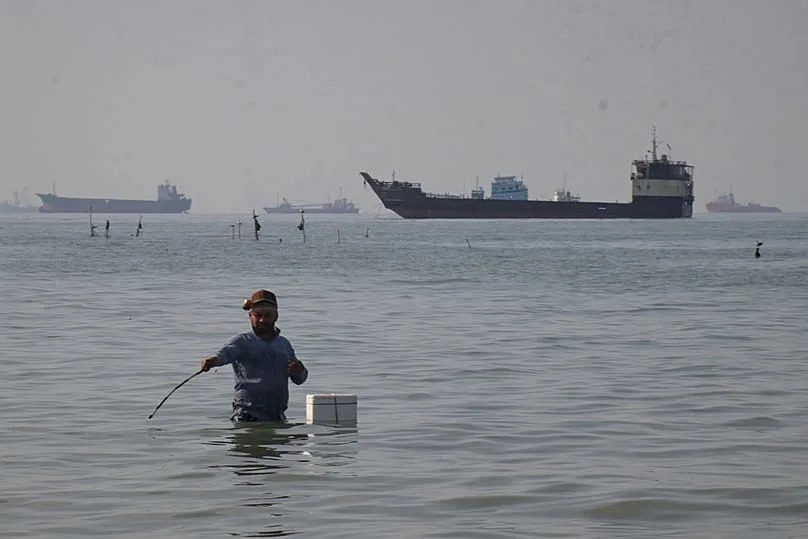 A man stands in the water as bulk carriers, cargo ships, and service vessels line the horizon in the Strait of Hormuz off Bandar Abbas, Iran, Monday, April 27, 2026 - Razieh Poudat/AP
By Malek Fouda EuroNews
US President Donald Trump said on Saturday that he was reviewing a new proposal from Iran to end the war but expressed early scepticism that it would lead to a deal.
“I’ll let you know about it later,” he said before boarding Air Force One, adding that “they’re going to give me the exact wording now.”
In a later post on Truth Social, the Republican president reiterated his initial stance, but did not provide more information about the proposal or any sticking points that may still be prevalent to block a potential deal from being reached.
“I will soon be reviewing the plan that Iran has just sent to us, but can’t imagine that it would be acceptable in that they have not yet paid a big enough price for what they have done to Humanity, and the World, over the last 47 years,” wrote Trump.

Two semi-official Iranian news outlets, Tasnim and Fars, believed to be close to Iran’s paramilitary Revolutionary Guard Corps (IRGC), said Tehran has sent a 14-point proposal via Pakistan in response to a nine-point US proposal.
Iran’s state-run media have not reported on the new proposal. Pakistan has hosted previous in-person negotiations between Iran and the United States in Islamabad, which have later broken down, with the US refusing to participate after Iranian delegations withdrew, citing distance and travel time.
Trump rejected a previous Iranian proposal this week. However, conversations have continued, and the three-week fragile ceasefire appears to still be holding.
The US president also has floated a new plan to reopen the Strait of Hormuz at the mouth of the Persian Gulf, where about a fifth of the world’s trade in oil and natural gas typically passes. The strategic waterway has been effectively closed to maritime traffic since the US-Israeli war started on 28 February.
In recent days, Iran suggested that it would allow vessels who paid a fee to securely pass through the waterway, eliciting an angry response from Washington.
The US has warned shipping companies they could face sanctions for paying Iran to pass through the chokepoint waterway, adding pressure in the standoff over control of it.
Washington warned on Friday against transfers not only in cash but also in “digital assets, offsets, informal swaps, or other in-kind payments,” including charitable donations and payments at Iranian embassies, reiterating its stance that it would not allow Tehran to “bully the global economy”.
Trump launched a naval blockade of all Iranian ports a few weeks ago in response to Iran’s refusal to allow maritime traffic in the strait. The US Navy reported that it had forced close to 50 vessels trying to enter and leave Iran to turn back, effectively strangling its economy.
The US president claimed numerous times that the naval blockade is causing losses to the tune of $500 million (€426 million) a day on Iran’s already struggling economy, which has been hit over the past decade with gruelling US and international sanctions, over its nuclear programme and human rights record.




Leave a reply





 The Times of Earth ( TOE) founded in 1999, is a multilingual newspaper that is printed and circulated in many countries including some parts of the United States and Canada. It is considered as the largest trusted & respected international multimedia news/financial information source of the world.