Ahead of Trump-Xi summit, China warns on US arms sales to Taiwan
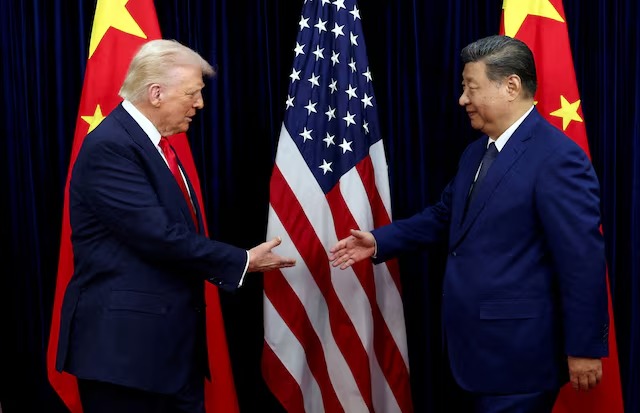 U.S. President Donald Trump shakes hands with Chinese President Xi Jinping as they hold a bilateral meeting at Gimhae International Airport, on the sidelines of the Asia-Pacific Economic Cooperation (APEC) summit, in Busan, South Korea, October 30, 2025. REUTERS/Evelyn Hockstein/File Photo/File Photo
China reiterated its strong opposition to U.S. arms sales to Taiwan on Wednesday, calling on Washington to honour its commitments ahead of U.S. President Donald Trump’s arrival for a summit in Beijing.
The issue of democratically governed Taiwan, which China views as its own territory, and weapons sales to Taipei is certain to be discussed during two days of meetings this week between Trump and Chinese President Xi Jinping.
The U.S. is bound by law to provide Taiwan with the means to defend itself, despite a lack of formal diplomatic ties. In December, the Trump administration announced an $11 billion weapons package for Taiwan, the largest ever.
Zhang Han, a spokesperson for China’s Taiwan Affairs Office, said Taiwan is an internal issue and a matter for the Chinese people.
“We firmly oppose the United States engaging in any form of military ties with China’s Taiwan region, and firmly oppose the United States selling weapons to China’s Taiwan region. This position is consistent and unequivocal,” she said in Beijing.
Taiwan is the “core of China’s core interests” and honouring the commitments made by successive U.S. administrations are “international obligations that the U.S. side is duty-bound to fulfil”, Zhang added.
The U.S. officially takes no position on Taiwan’s sovereignty under Washington’s “One China” policy, but acknowledges, without accepting, Beijing’s position that the island is China’s.
TAIWAN DEFENCE SPENDING
Trump will be in China less than a week after Taiwan’s opposition-controlled parliament approved only two-thirds of a $40 billion special defence budget that President Lai Ching-te had requested, funding U.S. arms purchases but cutting domestic programmes like drones.
A senior U.S. official said on Sunday that the U.S. was disappointed by the approval of defence spending short of what Washington believes is needed.
A senior Taiwan security official told Reuters that the biggest risk for Taipei was that Beijing would use that reduced budget as leverage with Trump.
China could “argue that Taiwan’s legislature opposes buying weapons and that the U.S. should respect the will of the Taiwanese people – in order to persuade President Trump to halt or reduce defence support for Taiwan”, the official added.
Reuters reported in March that a second arms package, worth some $14 billion, could be approved after Trump gets back from China, but its current status is unclear.
On Tuesday, Lai, who rejects Beijing’s sovereignty claims, told the Copenhagen Democracy Summit the island is a “sovereign, independent nation” and beacon of democracy that would not bow to pressure.
Zhang said that Taiwan is a part of China that has never been, and would never be, a country.
“Our resolve to oppose Taiwan independence is as firm as a rock, and our capability to crush Taiwan independence is unbreakable,” she said.
Wu Cheng, spokesperson for Lai’s Democratic Progressive Party, said it didn’t matter what China said because Taiwan had its own government, sovereignty, military and democracy and Lai would continue to let the world know of Taiwan’s “existence”.
China has never renounced the use of force to bring Taiwan under its control, but says its preferred option is “peaceful reunification”.
SOURCE: REUTERS AND AGENCIES


Leave a reply



 The Times of Earth ( TOE) founded in 1999, is a multilingual newspaper that is printed and circulated in many countries including some parts of the United States and Canada. It is considered as the largest trusted & respected international multimedia news/financial information source of the world.