
Trump warns of ‘economic D-Day’ against Iran, but Tehran is well acquainted with sanctions
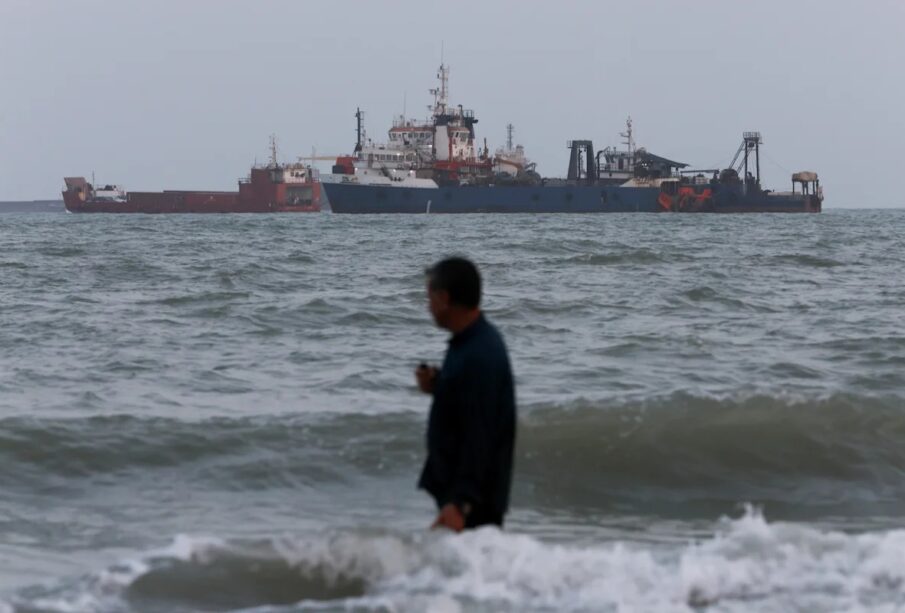 A person wades in the water as ships are seen anchored in the Strait of Hormuz on August 10, 2026, off the coast of Bandar Abbas, Iran [Ali Saeedi/Getty Images]
By FARNOUSH AMIRI AP | Posted by TOE
Nearing the six-month mark of the Iran war and facing diminishing stockpiles of key weapons, the Trump administration is touting a crushing financial campaign against Tehran, promising an “economic D-Day” against a country that has so far withstood nearly five decades of punishing American sanctions.
With sparse details, President Donald Trump announced this week that the U.S. would be imposing an “unprecedented” level of economic warfare and isolation on Iran, aiming to force its leadership to cave to demands to end its nuclear program and fully reopen the crucial Strait of Hormuz to oil and natural gas tankers.
It reflects the dire reality Trump faces with an increasingly unpopular war he can’t seem to end just months before pivotal midterm elections that will decide whether his Republican Party keeps control of Congress. Whether out of desperation or strategy, the president is refocusing America’s might on bringing Iran to its knees through an accelerated sanctions campaign against one of the most economically penalized countries in the world.
The immediate response from Iran hawks has been praise and a call for patience as it plays out, while other analysts warn that Trump is refusing to learn the lessons of his predecessors.
In an interview Thursday on CNBC, Treasury Secretary Scott Bessent offered a small glimpse of what may be ahead, threatening secondary sanctions on nations and companies that conduct business with Iran.
He did not say exactly whom would be targeted as part of this next phase of the administration’s ” Operation Economic Fury, ” which earlier had focused on entities and individuals that buy oil from or bank with Iran. China and India, however, are major buyers of Iranian oil.
“If you insist on doing business with them, then the U.S. Treasury and U.S. government will put its full might and force against you,” Bessent said. “It’s time for our allies and the rest of the world to make a decision.”
Some experts see ‘uncharted waters’ that could force Iran’s hand
Despite decades of U.S. sanctions against Iran, the Trump administration is arguing that it’s only a matter of time and that striking the right economic target would get Tehran to its breaking point.
Richard Goldberg, who coordinated efforts to put diplomatic pressure on Iran in Trump’s first term, said the consequences of U.S. strikes on Iran’s nuclear sites last year, the war this year and the American naval blockade on Iranian ports have created the perfect storm for capitulation — one that didn’t previously exist.
“I think we’re watching a strategy, whether it takes a short time or a long time, that is very much about fundamentally changing the future of the world by seeing the end of this regime,” said Goldberg, who is now at the hawkish Washington think tank Foundation for Defense of Democracies.
“I caution everyone — including myself, who has worked on sanctions, who’s worked on financial warfare — to have the humility to admit that we are in uncharted waters,” he said.
He said the decision this week by the United Arab Emirates — once one of Tehran’s most important trading partners — to suspend trade with Iran over an alleged missile attack will only further isolate the government.
Beyond trade in domestically produced goods, the Emiratis had helped the country absorb some of the shocks caused by sanctions through its re-export hub.
Targeting allies and partners comes at a price
With nearly all of Iran’s energy, financial and transportation sectors already covered by U.S. sanctions, Trump’s aim appears to be to apply secondary sanctions on countries, including allies and partners, that have not cut all ties with Iran to starve the country of any remaining income it may still be receiving.
In many ways, it is a redux of Trump’s first-term “maximum pressure” campaign, which he has ramped up during his second term to include military action.
But as Trump and his allies discovered during his first administration, it can be difficult to enforce secondary sanctions without harming U.S. interests and provoking reciprocal measures. There were numerous instances of the administration granting sanctions waivers to countries, particularly those that rely on Iranian oil for their energy needs.
“Trump’s strategy now rests on targeting Tehran directly by impeding its touch points and access to the formal financial system and international economy,” said Behnam Ben Taleblu, senior director of FDD’s Iran program. “This will require making the Iran issue more important in U.S. bilateral relations with countries in Europe and Asia.”
Iran doesn’t see an ‘open door’ at the end of the sanctions campaign
Iranian officials and analysts have accused the Republican president of flip-flopping with his latest pivot to economic pressure against Iran. Trump has long derided past leaders who used sanctions to limit Iran’s ability to pay for its military and nuclear development.
In a post last week on X, Esmail Baghaei, spokesman for Iran’s Foreign Ministry, wrote that Washington’s pattern of retreating to sanctions when it doesn’t want to pursue diplomacy has proven to be futile.
“Iran has demonstrated over decades that it will not be strangled by these exhausted refrains,” he said. “The real risk is that American politicians, clinging to this bad habit, will instead strangle their own remaining chances of a less humiliating exit from a crisis of their own making.”
Ali Vaez, Iran director at the International Crisis Group, said the Trump administration’s decision to take its own “maximum pressure” policy to new heights with military action seems to ignore years of U.S. foreign policy lessons that show Iran does not respond well to pressure.
If anything, he says, the latest economic campaign has only “hardened Iran’s position.”
“I think (Trump’s) blind spot is the fact that the only thing that the Iranian regime views as more dangerous than suffering from U.S. sanctions is surrendering to U.S. terms,” Vaez said.
Plus, the past year of start-stop diplomacy has only worsened the already fragile dynamic between the longtime adversaries, Vaez says, adding that Iranian officials’ lack of trust in Trump and his mediators has created an untenable foundation.
“They believe that even if they capitulate to U.S. terms under economic duress, Trump would move the goalposts and ask for more,” he said. “And this is really the fundamental problem: Pressure without an open door is an exercise in futility.”


Leave a reply



 The Times of Earth ( TOE) founded in 1999, is a multilingual newspaper that is printed and circulated in many countries including some parts of the United States and Canada. It is considered as the largest trusted & respected international multimedia news/financial information source of the world.