Iran tightens control of Hormuz after US calls off renewed attacks
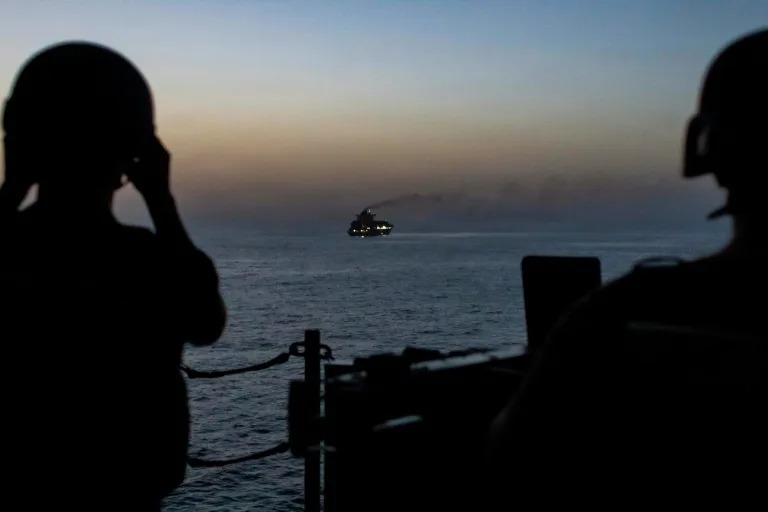 US forces patrol the Arabian Sea near an Iranian-flagged cargo ship ( NAVCENT PUBLIC AFFAIRS/AFP)
By Steve Holland, Parisa Hafezi and Saad Sayeed Reuters
Iran seized two ships in the Strait of Hormuz on Wednesday, tightening its grip on the strategic waterway a day after U.S. President Donald Trump announced he was indefinitely calling off attacks, with no sign of peace talks restarting.
The status of a two-week-old ceasefire, due to expire earlier this week, remained unclear. In a sharp about-face hours after threatening renewed violence, Trump made what appeared to be a unilateral announcement on Tuesday that the U.S. would extend a ceasefire until it had discussed an Iranian proposal in peace talks to end the two-month-old war.
But Iranian officials did not say they had agreed to any extension of the truce, and criticized Trump’s decision to maintain the U.S. Navy blockade of Iran’s trade by sea, itself considered by Iran an act of war. Iran’s parliament speaker and lead negotiator Mohammad Baqer Qalibaf said a full ceasefire only made sense if the blockade was lifted. Reopening the Strait of Hormuz, the slender chokepoint that carried a fifth of the world’s oil trade before the war, was impossible with such a “flagrant breach of the ceasefire,” Qalibaf said on social media.
“You did not achieve your goals through military aggression and you will not achieve them by bullying either,” he wrote in his first response to Trump’s announcement. “The only way is recognizing the Iranian people’s rights.”
Trump again backed away at the last moment from his repeated threats to bomb Iran’s power plants and other civilian infrastructure, which the United Nations and others warn would violate international humanitarian law. But little progress has been made in ending the war that started with joint U.S.-Israeli attacks on Iran on February 28.
That leaves the two sides in a holding pattern with the crucial Strait of Hormuz still effectively shut, straining economies across the world. Thousands of people have been killed across the Middle East, mostly in Iran and Lebanon, where the Iran-allied Hezbollah militant group joined the fighting against Israel.
The Islamic Revolutionary Guards Corps seized two vessels for what it called maritime violations and escorted them to Iranian shores, according to statements by the shipping companies and Iran’s semi-official Tasnim news agency. It was the first time Iran has seized ships since the war began at the end of February.
The Revolutionary Guards also warned that any disruption to order and safety in the strait would be considered a “red line”, Tasnim said.
Brent, the international crude oil benchmark, closed above $100 a barrel for the first time in two weeks. The ongoing blockade of the strait is driving up costs for businesses while major economies run down reserves and restrict consumption with millions of oil barrels cut off from key markets.
NO NEW DEADLINE FOR CEASEFIRE
In his Tuesday announcement, Trump said that the U.S. had agreed to a request by Pakistani mediators “to hold our Attack on the Country of Iran until such time as their leaders and representatives can come up with a unified proposal … and discussions are concluded, one way or the other.”
He has not set any deadline for the proposal or discussions, White House press secretary Karoline Leavitt told reporters.
Pakistan, which has acted as a mediator, was still trying to bring the sides together after both failed to show up for tentatively scheduled talks in Islamabad on Tuesday before the two-week-old ceasefire was due to expire.
Both Iran and the U.S.-Israel alliance have continued to claim to be winning the war. Iran showcased some of its ballistic weapons at a parade in Tehran on Tuesday evening, with images on state TV showing large crowds waving Iranian flags and a banner in the background with a fist choking off the strait.
Captions read: “Indefinitely under Iran’s Control” and “Trump could not do a damn thing”, referring to the strait, which Iran has effectively shut to ships other than its own and lately attacking vessels that attempt to transit without its permission.
The Revolutionary Guards accused the ships it had seized, the Liberia-flagged Epaminondas and Panama-flagged MSC Francesca, of operating without required permits and tampering with their navigation systems.
Greece’s Technomar Shipping confirmed its ship Epaminondas was captured. Epaminondas reported being fired upon about 20 nautical miles northwest of Oman, sustaining damage to its bridge, though no one was hurt in the incident.
MSC, the world’s biggest container shipping group, did not respond to a request for comment.
A third, Liberia-flagged container ship was fired upon in the same area but was not damaged and had resumed sailing, according to maritime security sources.
Leavitt, the White House spokeswoman, said in an interview with Fox News that since the ships were not U.S. or Israeli vessels the seizure was not a violation of the ceasefire. She called it an act of “piracy” and said the use of small gunboats showed that Iran’s navy had been destroyed and that Iran does not have control over the Strait of Hormuz.
Before the war, around 130 vessels crossed the strait each day, a figure that has plummeted to just a handful a day since fighting began.
The U.S. military said on Wednesday afternoon that it had so far directed 29 vessels to turn around or return to port as part of the U.S. blockade against Iran. Far beyond the Gulf, the U.S. military has also intercepted at least three Iranian-flagged tankers in Asian waters, sources said, redirecting them away from their positions near India, Malaysia and Sri Lanka.
U.S.-IRANIAN DIFFERENCES REMAIN
A first session of peace talks between Iran and the U.S. in Islamabad 11 days ago produced no agreement.
Trump wants Iran to give up highly enriched uranium and forgo further enrichment to prevent it building a nuclear weapon. Iran says it has only a peaceful civilian nuclear programme, and wants the lifting of sanctions, reparations for damage and recognition of its control over the strait.
Iran has also made a ceasefire between Israel and Lebanon’s Hezbollah militant group a condition of truce talks. On Wednesday, Israeli air strikes on Lebanon killed at least five people, including the Lebanese journalist Amal Khalil.
It was the deadliest day since a 10-day ceasefire was announced on April 16 between Israel and Lebanon.


Leave a reply




 The Times of Earth ( TOE) founded in 1999, is a multilingual newspaper that is printed and circulated in many countries including some parts of the United States and Canada. It is considered as the largest trusted & respected international multimedia news/financial information source of the world.