
Yemen’s Houthis claim attack on Aramco oil facility in Saudi Arabia
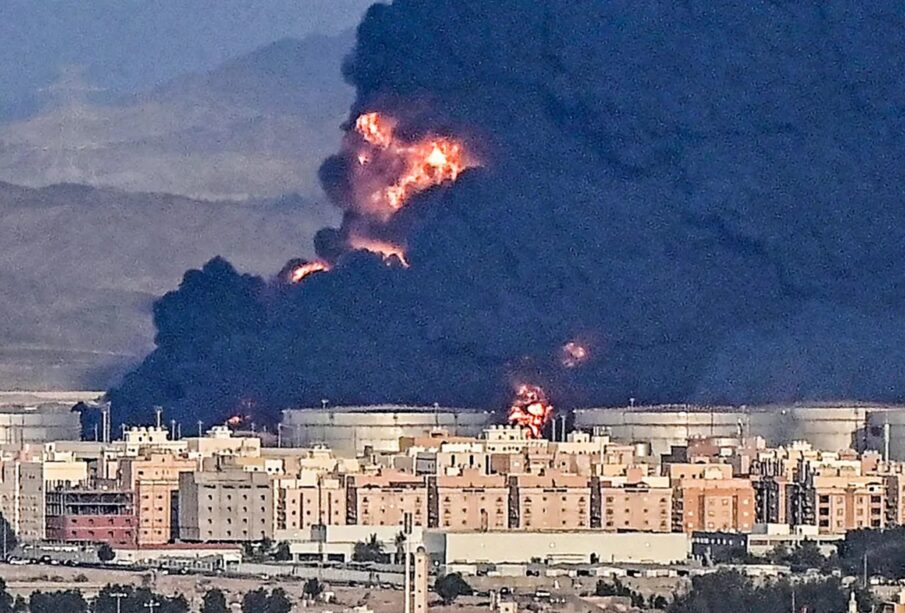 Smoke billows from an oil storage facility in Saudi Arabia’s Red Sea coastal city of Jeddah on March 25, 2022. Andrej Isakovic | AFP | Getty Images File
By Associated Press | Posted by TOE
Yemen’s Houthis said they attacked an oil facility Sunday in southwestern Saudi Arabia, the latest attack by the Iranian-backed rebels on the kingdom. Meanwhile, Iran has made new demands about the reopening of the Strait of Hormuz, and the Pentagon is pressing the U.S. defense industry to accelerate production of weapons.
Here’s a look at developments across the Middle East on Sunday. Full coverage can be found here.
Houthis target Aramco refinery
Yahya Saree, a military spokesperson for the Houthis, said they targeted an Aramco refinery in the city of Jazan with a drone. The attack was in response to Saudi drones’ breaching Yemen’s airspace over the provinces of Hajjah and Saada, he said.
Early on Sunday, the Saudi Energy Ministry reported a fire at a facility belonging to the Aramco refinery without casualties. The ministry said the fire was extinguished but it didn’t describe its cause.
Sunday’s Houthi attack is the latest in a series of missile and drone attacks that targeted Saudi Arabia and its shipping in the Red Sea. The escalation threatens to reignite Yemen’s civil war more than four years after a 2022 truce stopped major fighting in the impoverished Arab country.
— by Samy Magdy in Cairo.
Iran says the strait won’t open until the US ‘corrects’ its behavior
Iran’s powerful Supreme National Security Council said the Strait of Hormuz will not open until the United States “corrects its behavior,” issuing new demands that could shake up talks on a deal to manage the waterway.
Iran’s state broadcaster published the statement by the council’s secretary, Mohammad Bagher Zolghadr, who is also a commander in the powerful Revolutionary Guard.
The United States must never threaten Iran again, the statement said, and must permanently end the war with Iran and its armed allies in the region. The U.S. must lift the naval blockade of Iranian ports and withdraw its military from the area. It must “completely compensate” Iran for war damage, lift sanctions and “unconditionally” release frozen assets.
The U.S., which has wanted an acceptable deal first on the strait before ending the blockade, had no immediate comment. According to the interim deal signed in June, a schedule to end sanctions and plan on compensation would be part of the final deal, and negotiations would address frozen assets.
Pentagon pushes boost in weapons production
Pentagon spokesman Sean Parnell said in a statement Saturday that the department was actively focused on boosting munitions acquisitions to provide “the weapons our warfighters need at the pace the threat demands.”
The war with Iran has used up more of the U.S. military’s already diminished stockpiles of advanced missile interceptors, says a new analysis from the Center for Strategic and International Studies, a Washington think tank.
Parnell said the push for speedier delivery was part of a broader modernization effort that predated the five-month-old conflict.
Details emerge about potential Iran-Oman deal
The Strait of Hormuz, crucial to global supplies of oil and natural gas, was considered an international waterway before the war.
But Iran and Oman are working to finalize a temporary deal that would reopen the strait with ships entering the strait through a route close to Iran and exiting through a route close to Oman, according to two people familiar with the talks who spoke on condition of anonymity because they were not authorized to speak publicly.
Ships would cross the strait without paying fees or tolls during the interim period.

Leave a reply




 The Times of Earth ( TOE) founded in 1999, is a multilingual newspaper that is printed and circulated in many countries including some parts of the United States and Canada. It is considered as the largest trusted & respected international multimedia news/financial information source of the world.