
Iran, US agree to halt war and reopen Hormuz, sending oil prices tumbling
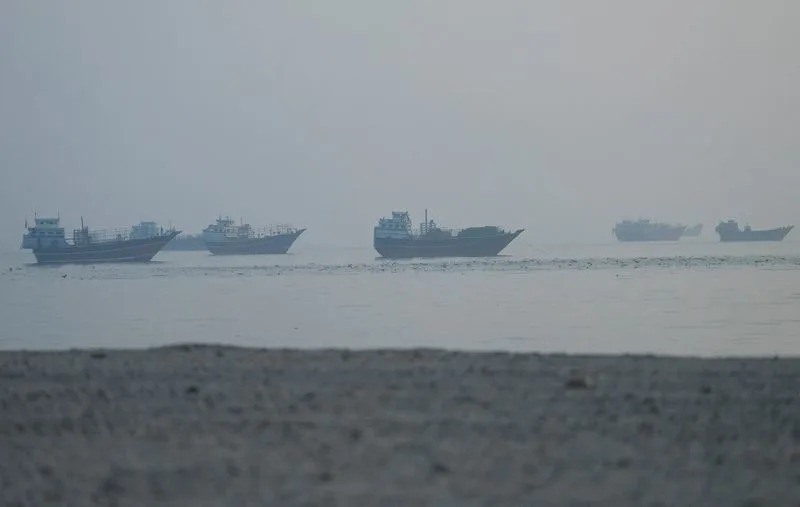 Vessels in the Strait of Hormuz, as seen from Musandam, Oman, June 15, 2026. REUTERS/Stringer
By Parisa Hafezi, Yomna Ehab and Humeyra Pamuk Reuters and by TOE
U.S. and Iranian officials said they had reached an agreement to end their war and reopen the Strait of Hormuz, a preliminary pact that sent oil prices falling but leaves the fate of Tehran’s nuclear program to further negotiations.
While still a framework, the deal marked the biggest breakthrough towards resolving the conflict that has killed thousands and upended energy markets since it began with joint U.S.-Israeli strikes on Iran in February.
“The Deal with the Islamic Republic of Iran is now complete,” U.S. President Donald Trump wrote on his Truth Social platform at around 5:30 p.m. in Washington (2130 GMT) on Sunday. His post came shortly after Pakistani Prime Minister Shehbaz Sharif, whose country has served as a mediator, announced a deal had been struck early on Monday local time.
The memorandum of understanding is scheduled to be officially signed on Friday in Switzerland.
The precise terms were not immediately known. Sharif said in a post on X that the pact called for “the immediate and permanent termination of military operations on all fronts, including in Lebanon.”
LEBANON HAS BEEN A STICKING POINT
Lebanon has suffered the deadliest spillover of the conflict, with thousands of people killed and some 1.2 million people uprooted by an Israeli offensive against the Iran-backed Hezbollah group, which opened fire on Israel in support of Tehran on March 2.
The country has been a sticking point in negotiations, with Israel and Hezbollah ignoring calls from Trump and others to stop their attacks on each other in recent weeks.
The secretariat of Iran’s Supreme National Security Council said war and military operations on all fronts, including Lebanon, would end permanently starting on Monday night.
Iran’s Foreign Minister Abbas Araqchi said there must be a complete halt to Israeli attacks against Lebanon and wrote on Telegram that the U.S. bears responsibility for implementing the framework deal.
Nabih Berri, speaker of the Lebanese parliament and a Hezbollah ally, said the deal laid the foundation for security and stability in the region, including in Lebanon.
Israeli Prime Minister Benjamin Netanyahu has yet to respond publicly to the U.S.-Iran agreement.
But Defence Minister Israel Katz said that Israel would oppose any pressure to withdraw its forces from areas it is occupying in southern Lebanon.
“This is the main lesson from the events of October 7,” Katz said. “Prime Minister Netanyahu made this clear to U.S. President Trump and other senior American officials, and I also clarified it yesterday to U.S. Defense Secretary Pete Hegseth.”
STRAIT TO REOPEN
Iran’s deputy foreign minister, Kazem Gharibabadi, said a more expansive agreement on the wider conflict would be negotiated during a 60-day ceasefire period, including sanctions relief for Iran.
The fate of Iran’s nuclear program, another thorny issue, will also be addressed in those later talks, sources previously told Reuters.
Trump said the Strait of Hormuz, a major shipping route for global oil and gas supplies that Iran has effectively shut down for months, would open on Friday, and that he had ordered the end of the U.S. blockade of Iranian ports.
“Ships of the World, start your engines. Let the oil flow!” Trump wrote.
Oil prices fell on the news. Brent crude futures fell 4% in early trading on Monday while stock markets jumped.
The war has become a political liability at home for Trump and his fellow Republicans in Congress, with public opinion polls showing Americans deeply frustrated by rising gas prices ahead of November’s midterm elections. But Trump has also faced pressure from members of his own party who insist that Iran’s nuclear program must be completely shut down.
During his first term, Trump withdrew the U.S. from a 2015 multilateral Iran deal, negotiated by Democratic President Barack Obama, that lifted sanctions on Tehran in exchange for limits on its nuclear program and international inspections.
Iran responded by ramping up its enrichment of uranium, producing more than 400 kg (around 900 pounds) of material at close to bomb-grade purity.
RELEASE OF FROZEN ASSETS
The agreement was sealed despite an Israeli strike on Lebanon on Sunday that drew criticism from both Iran and Trump.
Netanyahu has disregarded American demands that Israel curb its military action in Lebanon to allow the U.S. to reach a deal with Iran, saying it will retain freedom of operations there. Meanwhile, Iran made a full ceasefire in Lebanon an important component of its demands.
Leaders outside the Middle East welcomed the announcement.
In a joint statement, Britain, Germany, France and Italy said they were prepared to lift sanctions on Iran in response to “clear, verifiable steps” to limit its nuclear program.
China also welcomed the deal.
Before the deal was announced, a senior Iranian official told Reuters that, under the terms of the draft, the U.S. would agree to release $25 billion of frozen Iranian assets. The Trump administration has previously said any release of Iranian money would only take place once Iran has fulfilled certain conditions under a peace deal.
A U.S. official, also speaking before the announcement, said the agreement would ultimately lead to the dismantling of Iran’s nuclear program, with its stockpile of highly enriched uranium to be destroyed and removed. The senior Iranian official said the draft deal would allow Iran, which denies seeking a nuclear bomb, to dilute its enriched uranium inside the country.


Leave a reply



 The Times of Earth ( TOE) founded in 1999, is a multilingual newspaper that is printed and circulated in many countries including some parts of the United States and Canada. It is considered as the largest trusted & respected international multimedia news/financial information source of the world.