
Trump criticises allies over rejection of Hormuz request, as Iran and Israel trade airstrikes
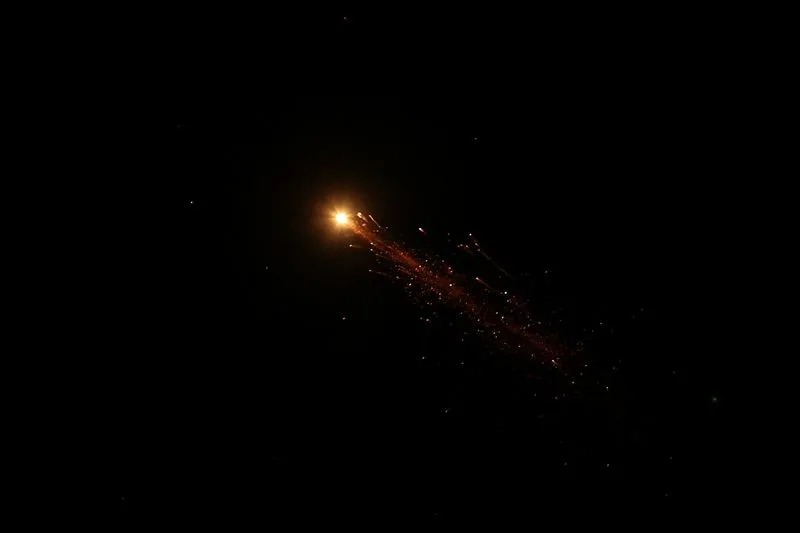 Streaks of fire and light slash across the night sky as an Israeli interceptor strikes an Iranian missile amid the U.S.-Israeli conflict with Iran, over Tel Aviv, Israel, March 17, 2026. REUTERS/Tyrone Siu
By Alexander Cornwell and Jonathan Landay Reuters
U.S. President Donald Trump accused some Western allies of ingratitude after several countries rebuffed his demand to send warships to escort oil tankers through the Strait of Hormuz, as Iran continued to target oil facilities in the Gulf.
The U.S.-Israeli war on Iran is in its third week with no end in sight. The critical Strait of Hormuz, through which 20% of the world’s oil and liquefied natural gas flow, remains largely closed off, raising energy prices and fears of inflation.
A number of U.S. partners, including Germany, Spain and Italy, said they had no immediate plans to send ships to help reopen the strategic waterway, which Iran has effectively shut with drones and naval mines.
“We lack the mandate from the United Nations, the European Union or NATO required under the Basic Law,” German Chancellor Friedrich Merz said in Berlin, adding that Washington and Israel had not consulted Germany before launching the war.
Trump, speaking at a White House event in Washington, said many countries had told him they were prepared to help, but voiced frustration with some long‑standing allies.
“Some are very enthusiastic about it, and some aren’t,” he said, without offering specifics. “Some are countries that we’ve helped for many, many years. We’ve protected them from horrible outside sources, and they weren’t that enthusiastic. And the level of enthusiasm matters to me.”
DRONES AND MISSILES STRIKE ACROSS THE REGION
There was no let-up in attacks by both sides early on Tuesday, with the Israeli military saying it was targeting “Iranian regime infrastructure” across Tehran, as well as Hezbollah sites in Beirut, a day after saying it had drawn up detailed plans for at least three more weeks of war with Iran.
Iran launched overnight attacks on Israel, underscoring that, more than two weeks into the war, Tehran still retains the capacity to carry out long-range strikes. It also targeted the United Arab Emirates, where attacks forced the temporary closure of airspace and a drone hit an oil facility in Fujairah, a key port for Emirati oil exports, for a second consecutive day.
On Monday, Dubai International Airport, typically one of the world’s busiest, was closed for several hours; oil loading operations in Fujairah were halted, and operations at the Shah gas field in Abu Dhabi were suspended following drone strikes.
Iran has said that a U.S. attack over the weekend on military sites at Kharg Island, a key hub for the country’s oil exports, was launched from the UAE, and warned that it would target oil and gas facilities in any country from which U.S. strikes on the island were carried out.
Iran has also said that it would target U.S. industrial facilities in the Middle East and urged people living near U.S.-owned plants to leave.
Rockets and at least five drones also targeted the U.S. embassy in Baghdad early on Tuesday, Iraqi security sources said, describing it as the most intense assault since the war began. Two U.S. officials said no injuries were reported so far.
‘NOBODY EXPECTED THAT. WE WERE SHOCKED’
Trump said earlier on Monday that Iran’s retaliatory strikes against its neighbours including Qatar, Saudi Arabia, the United Arab Emirates, Bahrain and Kuwait were a surprise.
“They (Iran) weren’t supposed to go after all these other countries in the Middle East,” he said. “Nobody expected that. We were shocked.”
However, Trump was warned that attacking Iran could trigger retaliation against U.S. Gulf allies, according to a U.S. official and two sources familiar with U.S. intelligence reports.
Oil prices rose more than 2% in early trade on Tuesday, reversing some of the previous session’s losses, on worries about supply, while Asian shares also rallied after Monday’s sell-off.
The war has killed at least 2,000 people across the Middle East since the U.S. and Israel attacked Iran on February 28, including at least 200 children in Iran, according to Iranian Foreign Minister Abbas Araqchi.
At a burial site in Iran on Monday, Marzia Rezaei wept for her son Erfan Shamei, who died in a blast at a military training camp days before he was due home on leave.

Leave a reply




 The Times of Earth ( TOE) founded in 1999, is a multilingual newspaper that is printed and circulated in many countries including some parts of the United States and Canada. It is considered as the largest trusted & respected international multimedia news/financial information source of the world.