
Israel bombs Beirut after Hezbollah launches rocket attack
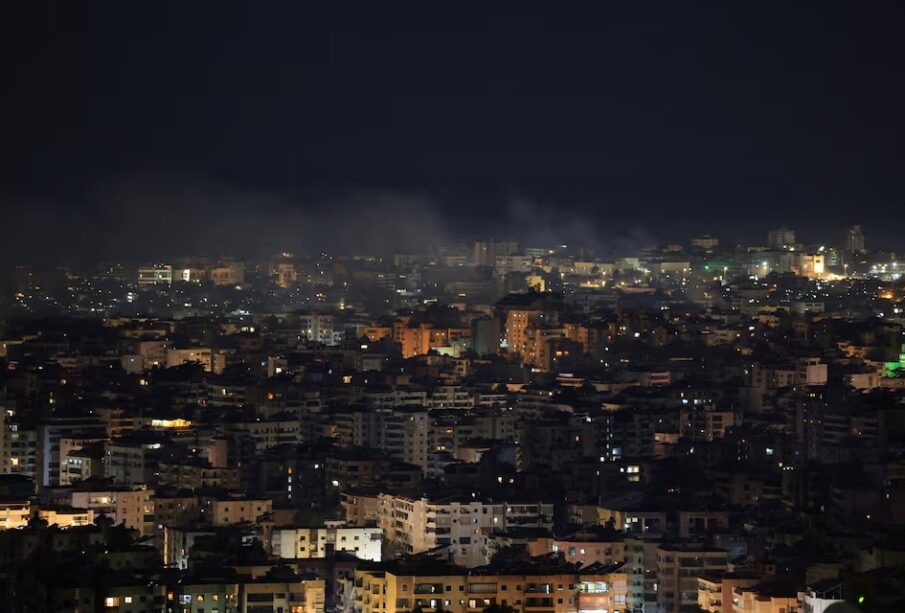 Smoke rises after Israeli strikes in Beirut's southern suburbs, Lebanon, March 2, 2026. REUTERS/Mohamed Azakir
By Nader DURGHAM AFP
Israeli forces launched strikes on Lebanon including the capital Beirut on Monday, the military said, after Tehran-backed militant group Hezbollah fired rockets at Israel in retaliation for the killing of Iran’s supreme leader.
An AFP journalist heard several loud explosions in Beirut early on Monday, the Israeli military said it had “begun striking targets of the Hezbollah terrorist organisation across Lebanon”.
Residents in southern Lebanon fled on cars, some with mattresses tied to the roof, an AFP journalist saw, after Israel issued a mass evacuation warning.
The Israeli strikes followed rocket and drone launches from Lebanon, the first attack on Israel claimed by Hezbollah since a November 2024 ceasefire agreement that followed more than a year of war between them.
Hezbollah has been weakened from conflict with Israel, which it entered to support Hamas following the Palestinian militant group’s deadly attack on Israel in October 2023 and the subsequent war in the Gaza strip.
Israel has carried out regular strikes on Lebanon since the ceasefire came into effect, usually saying it targets the militant group and accusing it of truce violations.
On Monday, a military statement said Israeli forces “precisely struck” senior Hezbollah members in the Beirut area, and another in the south.
Lebanon’s state-run National News Agency (NNA) reported Israeli strikes across the country, including in Beirut’s southern suburbs where Hezbollah holds sway.
Israel then issued a warning to residents of about 50 towns and villages in Lebanon’s south and east — both Hezbollah strongholds.
“Hezbollah’s actions force the IDF (army) to act against it… For your safety, evacuate your homes immediately and move at least 1,000 metres (0.6 miles) away from your village to open areas,” army spokeswoman Ella Waweya said in a statement on X.
Hezbollah earlier claimed responsibility for the rocket and drone attack on Israel, which it said was retaliation for the killing of Iranian supreme leader Ayatollah Ali Khamenei in a wave of US-Israeli strikes on Tehran at the weekend.
It was also “in defence of Lebanon and its people, and in response to the repeated Israeli attacks”, Hezbollah said.
An official from the group had told AFP last week that Hezbollah would not intervene militarily in the event of “limited” US strikes on its backer Iran, but would consider any attack against Khamenei a “red line”.
– ‘Irresponsible’ –
Lebanese Prime Minister Nawaf Salam, whose government has pushed for Hezbollah’s disarmament, called Monday’s rocket fire “irresponsible”.
Such action “endangers Lebanon’s security and safety, and gives Israel pretexts to continue its attacks on it”, Salam said on X.
Without naming Hezbollah, Salam vowed to “stop the perpetrators and protect the Lebanese people”.
Salam will convene an emergency meeting on Monday “to discuss the developments… and to take the necessary measures”, his office said in a statement.
President Jospeh Aoun said attacks from Lebanese territory risk drawing the country into regional conflict.
He condemned the Israeli strikes, but warned against actions that could make Lebanon an arena of regional “wars unrelated to us”.
The Israeli military said that “several projectiles” fired from Lebanon on Monday “fell in open areas”, with no immediate reports of damage or injuries.
About three hours later, air raid sirens warning of an incoming drone in parts of Israel’s north.
“Hezbollah opened a campaign against Israel overnight, and is fully responsible for any escalation,” military chief Eyal Zamir said, according to a statement.
Lebanon’s NNA reported “major displacement” from Beirut’s southern suburbs and the country’s south, near the Israeli border, as residents tried to escape the areas.
Footage on local media showed roads filled with cars leaving the southern suburbs.
Further south on the Mediterranean coast, an AFP journalist in Sidon saw huge lines of cars packed with families arriving from the direction of the border.
The prime minister’s office shared a list of public schools available to shelter displaced people.
Lebanese authorities had repeatedly said they do not wish to involve their country in the outbreak of conflict in the region, which started after a massive US-Israeli attack on Iran.
That prompted a wave of missile and drone attacks from the Islamic republic on Israel and Gulf nations that host US bases.

Leave a reply



 The Times of Earth ( TOE) founded in 1999, is a multilingual newspaper that is printed and circulated in many countries including some parts of the United States and Canada. It is considered as the largest trusted & respected international multimedia news/financial information source of the world.