Nasry Asfura declared winner of Honduras presidency
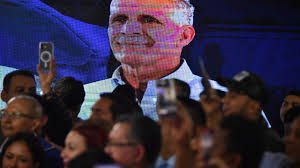 Honduran presidential candidate Nasry Asfura has been declared winner in a razor tight election where he had US President Donald Trump's support (Orlando SIERRA/AFP)
By Joan Suazo AFP
Nasry Asfura, a conservative businessman backed by US President Donald Trump, was declared winner of the Honduran presidential vote Wednesday, weeks after a razor-thin election marred by delays and allegations of fraud.
The national electoral council CNE said the 67-year-old son of Palestinian immigrants defeated fellow conservative TV personality Salvador Nasralla by less than one percentage point
Asfura’s victory marks the return of the right wing to power in one of Latin America’s poorest countries after four years of leftist Xiomara Castro’s presidency.
It also aligns Honduras with a rise of conservative governments in the region following shifts in Chile, Bolivia, Peru and Argentina.
“Honduras: I’m ready to govern. I won’t let you down,” Asfura posted to X after the win was declared, thanking election officials for validating his victory.
Asfura, who takes office on January 27, prevailed with just 40.1 percent of the vote, narrowly beating Nasralla at 39.5 percent, according to the official results.
Rixi Moncada, a lawyer from the leftist Libre Party, which currently runs the government, trailed in third with 19.2 percent.
Within minutes of the result declaration, the United States welcomed the election of Asfura, saying it would help stop illegal immigration.
“We look forward to working with his incoming administration to advance our bilateral and regional security cooperation, end illegal immigration to the United States, and strengthen the economic ties between our two countries,” Secretary of State Marco Rubio said in a statement.
Following the lengthy counting process in the Central American country’s election, Rubio called on all sides to “respect the confirmed results so that Honduran authorities may swiftly ensure a peaceful transition of authority.”
Argentina’s President Javier Milei, a Trump ally, said on X that the Honduras vote amounted to “a resounding defeat of narco-socialism.”
– Tensions, challenges –
The result was announced more than three weeks after the November 30 election. The wait for the outcome has caused tensions among Hondurans, and the sluggish count has been accompanied by claims of irregularities and voter fraud.
Nasralla had demanded a full recount due to alleged irregularities, and has not recognized Asfura’s victory.
The recount of nearly 2,800 tally sheets with suspected inconsistencies was pored over by hundreds of electoral staff and political delegates to decide the race.
The CNE had until December 30 to declare a winner.
Last week, thousands of supporters of the outgoing president’s leftist Libre Party staged a demonstration in the capital Tegucigalpa to protest what they consider “fraud” in the vote.
On the eve of the election, Trump in a surprise move pardoned former Honduran president Juan Orlando Hernandez, a member of Asfura’s party who was serving a 45-year prison sentence in the United States for drug trafficking.
Extradited by Honduras to face justice in the United States, Hernandez insists he had been set up by the previous administration of US president Joe Biden because of his conservative policies.
The pardon was widely seen as contradicting Trump’s crackdown on alleged drug traffickers in Latin America.
Trump also endorsed Asfura, suggesting they could “work together to fight the narcocommunists,” and warned “there will be hell to pay” if the conservative candidate’s razor-thin lead was overturned in the count.
On Wednesday Hernandez took to X to congratulate Honduran voters, saying the country “closes a cycle and opens a new era with hope, commitment and responsibility.”
Asfura faces major challenges. He has pledged to attract foreign investment to the nation of 11 million people and re-establish ties with Taiwan — after his predecessor warmed to China in 2023.
He will govern a more polarized country amid lingering doubts about the elections, which Castro said was under “serious question” due to a lack of transparency, coercion of voters by gang members, and “threats” from Trump.
Honduras is also plagued by violence and the crime of drug traffickers and major gangs, which Castro has struggled to combat despite declaring a state of emergency.
Although murders have declined, Honduras remains one of the region’s most violent countries, with some 27 homicides per 100,000 inhabitants in 2024.


Leave a reply



 The Times of Earth ( TOE) founded in 1999, is a multilingual newspaper that is printed and circulated in many countries including some parts of the United States and Canada. It is considered as the largest trusted & respected international multimedia news/financial information source of the world.